"I have a mind like a steel... uh... thingy." Patrick Logan's weblog.

Search This Blog

Sunday, October 14, 2007

Planned RESTful Services

Stu says stuff about reuse...

From this viewpoint, "build it and maybe people will use it later" is a bad thing. SOA proponents really dislike this approach, where one exposes thousands of services in hopes of serendipity -- because it never actually happens.

Yet, on the Web, we do this all the time. The Web architecture is all about serendipity, and letting a thousand information flowers bloom, regardless of whether it serves some greater, over arching, aligned need. We expose resources based on use, but the constraints on the architecture enables reuse without planning. Serendipity seems to result from good linking habits, stable URIs, a clear indication of the meaning of a particular resource, and good search algorithms to harvest & rank this meaning.

This difference is one major hurdle to overcome if we are to unify these two important schools of thought, and build better information systems out of it.

The early "mashups" were certainly serendipitous. I would expect most service providers on the web today are planning for machine-to-machine to a much greater extent than even a couple of years ago.

Is it really "serendipitous" when an organization follows those good web practices and enters formal-enough agreements with participants, say in an intra-enterprise-services situation? No, that seems very much "planned". The biggest hurdle may be the addition, perhaps, of a stronger demand to negotiate terms for support and upgrades.

This is necessary of any kind of service, networked or otherwise, that has significant risks to stakeholders. If you buy SAP systems and bring them in-house, or if you network out to Salesforce, you negotiate terms of service with in-house IT, with the vendors, with the ISPs, etc.

Saturday, October 13, 2007

Scalability Requirements

Stefan Tilkov and Dare Obasanjo debate the number of big sites that would benefit from giving up on the relational database as a centerpiece of their systems. The parameter used in the discussion is scalability.

A number of the lessons learned from these big web sites could apply to smaller data center designs as well. The biggest problem I've seen in the typical data center, and from comparing notes, seems fairly common, is the ability evolve components relatively independently.

Relational databases can be in the mix and still evolve, just as more supposedly "loosely coupled" mechanisms can actually tie components tightly together. For example some systems may use asynchronous messaging to decouple with respect to time, but then pass to each other data that exposes implementation details. And so these systems are coupled to each other with respect to maintenance and enhancements: changing the implementation of component C demands corresponding changes to every other component that consumes component C's implementation-specific messages.

But the lessons are worth following for more reasons than just scalability.

Content Unbecoming

Sam Ruby comments in his own blog...

I will merely point out that I’ve dealt with formats and protocols which are “explicitly not intended for human readability” and I’ve learned to avoid them.
And Bill de hÓra comments further down...
Atompub/Atom shines light on the fact we have serious issues around sharing and “understanding” structured content. Complaining about the source of light isn’t sensible.

So, to me, this is like the web services debates rehashed half a decade later. The only interesting difference in this thread is the level the argument is happening - around the content/payload/mediatype instead of wire/transfer...

Maybe it’s not as obviously random at this time to argue that per silo data access formats are a good idea...

Fwiw, “technically”, I don’t see why facebook don’t serve class laden XHTML and document the attributes.

And along the way James Snell compares to Yaron's example...
<entry xmlns="http://www.w3.org/2005/Atom">
  <id>tag:example.org,2005/someuser/profile</id>
  <title>Some User's Profile</title>
  <updated>2000-01-01T00:00:00Z</updated>

  <author><name>Profile System</name><author>
  <content type="xhtml">
    <div xmlns="http://www.w3.org/1999/xhtml">
      <div class="profile">
        <div class="section" id="professional">

          ...
        </div>
        <div class="section" id="personal">
          ...
        </div>
        <div class="section" id="clothingPreferences">
          ...
        </div>

      </div>
    </div>
  </content>
</entry>
Looks good. Damn. Even *this* xml-hater (yours truly) has had trouble realizing all that one-off stuff is bogus.

Don't Fear the Programmer

Not to beat a dead horse, but Robert Cooper adds an important point to the enterprise development tool conversation...

And here is where it breaks down. All these unusable drag and drop tools, and “easy” XML programming languages aren’t targeted at programmers. They are targeted to suits who can buy into the idea that some non-techy is going to orchestrate these services and modify business rules. These products are unworkable because they are based on the idea that “You won’t need programmers anymore!” at least at a core level. Once you make that assumption you start building things that get in programmers way, and still include enough abstract programming concepts that no non-programmer is ever going to be able to work with it proficiently
I've not heard this lately, but in previous situations this point was widely held: BPM tools should be used to get the programmer out of the loop. I always enjoyed bringing testing into the conversation. The current crop of BPM tools I've seen up close are terrible at incremental development, testing, and release. And yet at least some IT shops have seen them as *the* way to get from under long software development cycles.

Those shops I know of also happen to be historically lacking good automated testing and release practices. Most of their causes for long development cycles have almost *nothing* to do with programmers, save for the fact that most programmers historically have not paid much attention to good testing either. Of course that's changed dramatically over the last five years or so.

Managers: if you have long development cycles, backlogs of feature requests and bugs, and "legacy code" that seems impenetrable, then please embrace your programmers' desires to be more productive and effective. There are many things you can do today to make big improvements. Buying tools that will reduce the need for programmers is a pipe dream for now.

Friday, October 12, 2007

Sad IP

So let me get this straight -- Novell and Redhat are being sued over a patent some mangy IP shop bought that originated at Xerox PARC (I suppose Rooms?). And the patent is about making the same window show up in multiple workspaces?

This is the best IP some mangy techno-lawyer can pin on *Linux*?

Em, wow. Crawl back under your rock until you can make it *really* interesting... Next.

And note to Steve Ballmer: stop being such a wuss. You're really just appearing pretty sad these days. Can't you get a ride in space or something?

Monday, October 08, 2007

Friday, October 05, 2007

Bungie Cuts the Cord, So to Speak

Wow. This is huge. This speaks volumes between the lines and in the lines themselves. Just as Halo 3's $300MM USD is ballyhooed all over the press.

Just when there's all this buzz about how even enterprise applications are should become more game-like, and just as Microsoft must be getting desperate to show they can innovate, Bungie obviously takes off in order to be more innovative with game development than they can be as part of Microsoft.

Todd Bishop's Q&A is great. Maybe he could interview U.S. presidential candidates?

Say it Once Again

Pete Lacey: What is SOA?. Nicely done.

The definition of SOA is still an argument after all these years. This is a darn good sign that we should not care to use the term at all.

Equivocate: To avoid making an explicit statement. See Synonyms at "lie".

Mark Baker wisely points out...

There are, of course, a very large number of automated solutions to a particular problem.

...if you don’t feel disdain towards a lot (97%?) of these solutions, then you simply don’t understand what it means to be a software architect.

There is too much equivocation in our field. It's hard enough building software when you've got good tools at hand.
e·quiv·o·cal (-kwv-kl)
adj.
  1. Open to two or more interpretations and often intended to mislead; ambiguous. See Synonyms at ambiguous.
  2. Of uncertain significance.
  3. Of a doubtful or uncertain nature.

Thursday, October 04, 2007

Oh Dear, Part VII

Arnon Rotem-Gal-Oz assumes the position...

One thing that is missing from "HTTP variety of REST" implementation is reliable messaging. Location transparency is harder to solve with HTTP etc...

The solution should match the problem, that's probably the primary reason why we need architects after all.

Please Don't Pick on the Donkey

More Steve...

REST is unproven. Sigh. I can’t decide if people say this because they’re just trying to stir up an argument, or they’re so heavily biased toward their non-REST approaches that they just can’t even consider that there might be viable alternatives, or they really have no clue about what REST is, how it works, and why it works, and they’re not interested in learning it, so they just react badly whenever they hear it, or all of the above. If you’re anti-REST or REST-ignorant, and you haven’t read RESTful Web Services, then don’t even talk to me about REST. The book is absolutely wonderful, and its explanations and answers are extremely clear. If you consider yourself informed and capable when it comes to distributed systems and integration, but you don’t know REST, then there’s simply no way you can read that book and not have it lead you to seriously question your core beliefs regarding how you think such systems should be built, unless you’re completely close-minded of course...

What do mono-language programmers have to do with ESBs? It’s all part of the same culture, the “one size fits all” approach, where you have answers looking for problems rather than the other way around, and where people intentionally wear blinders to less expensive, more productive, and far more flexible and agile approaches because “it’s just not the way we do things around here.”...

At the end of the day, if you want to ignore my advice on using REST and dynamic languages, that’s your own problem.

And where his previous post received a comment, apparently from a Neudesic employee (ever heard of Neudesic???)...
Sonic Software, BEA, IBM, IONA, TIBCO, webMethods, Cape Clear, Fiorano, Oracle, Software AG, Neudesic, And how many open source projects????

All deliver ESB’s. It seems highly unlikely that all of these organizations, with plenty of smart folks, could be incorrect. Moreover, Gartner, Forester, ZapThink, and Burton, all speak loudly about ESB’s being an enabling technology on the road to building workable SOA’s.

Oh, dear. Steve responds best...
Making a list of smart companies to prove a point, well, doesn’t actually prove anything. I bet there are some actual smart people out there who have locked themselves out of their car, for example, or deleted whole directories they really wanted to keep but never backed up, or even paid actual money for a Zune. What does that prove?...

Unlike most of the commenters on this posting, I’ve personally built at least one of everything I’m talking about, on the ESB side and on the REST side, so I’m extremely confident in my opinion. I’d therefore much rather get specifics from you.

The View From Here Is... Grisly?

Joe Wilcox on MSFT Vista, speaking of big software the world is leaving behind...

The results, while arguably anecdotal, are grisly...

"Everyone—every single person—that I put on Vista has switched back to XP," he said. "It's too complicated."

From an administrator's perspective, my VAR buddy likes some Vista deployment tools, but he viciously complained about poor driver support, networking changes and end user complaints about UAC (User Account Control) and Internet Explorer 7 security popups.

In this ringing Vista endorsement, one Microsoft Watch commenter claimed: "I'm an IT consultant and I'm proud to announce I've formatted 450 Windows Vista machines back to Windows XP to date. I have also prevented at least 1,000 Windows Vista sales."

...the relevance of Windows is in decline. Microsoft's desktop operating system is rapidly becoming a commodity.

LAMP

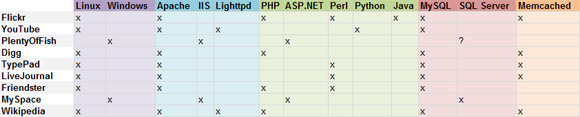
Her royal pingdom lists...

OS: Linux 7 - Windows 2
Web server: Apache 7 - IIS 2 - Lighttpd 2
Scripting: PHP 4 - Perl 4 - ASP.NET 2 - Python 1 - Java 1
Database: MySQL 7 - SQL Server 1 (possibly 2)
And you should not be investing in some reasonable approximation to LAMP, again, because...?

Protected Game Preserves

That's how Bob Warfield refers to how Adobe, Microsoft, and SAP are approaching Software as a Service (SaaS). There's something different about Adobe relative to the other two.

Microsoft and SAP are figuring out how to transition gigantic cash cows into a world that is rapidly leaving them behind. Not so much for Adobe.

Adobe bought BuzzWord. They now have an early beta of an interesting word processor. They also have a few more apparently kickass flash/flex developers and creative software designers.

As opposed to MSFT's and SAP's situations, the fact that BuzzWord doesn't compete with other current Adobe products is probably an advantage. BuzzWord as a product may or may not ever matter.

Adobe's strengths in the new world appears to be (1) graphics, especially as they become more web-friendly, e.g. Thermo is hot.

And (2) their own decent runtime from Macromedia, something relatively easy to build upon compared to java or dotnet, from a company with decent developer relationships.

I think considering the company as a whole, Adobe has some good stuff to take into the new world. MSFT and SAP have bigger transitions to make, product-wise and company culture-wise. Not that I would bet much against them, because they are f'ing big and know how to sell software to vice presidents.

Properly Striking a Balance Between Shared Agreement and Decentralized Execution

Stu Charlton of BEA says stuff on the ESB brouhaha, but then he says some really crucial stuff we all need to consider...

I like ESBs if they're used properly -- to me, a good ESB is actually just a scripting language with supporting infrastructure. AquaLogic Service Bus, to me, is a Pipeline language, an XQuery language, and the supporting management & interoperability infrastructure, for example. But an ESB is not mandatory, and sometimes can slow you down if you're not looking to make legacy systems interoperate.
Wow. Equating Aqualogic with a scripting language. That's bold.
I agree with Steve Vinoski's The ESB Question. Don't use an ESB if it's going to slow you down. ESBs are a decent, productive tool for SOA (and even REST!) when applied properly, but so are Python or Ruby. ;-)
I want to like what Stu's saying, but his sprinkling of "properlies" just seems like equivocation.
BEA tries really hard to make Jython supported in WebLogic and AquaLogic, for example. The whole JMX object model is scriptable, and you can do some amazing things with it. And we have PHP running on WebLogic Server.
OK. I kicked the tires on Aqualogic over a year ago. I did not appreciate it any more than other ESBs, and found Jini/Javaspaces significantly more productive.

But I like the parts about Jython and PHP.

What gives? Perhaps two things:
  1. software has long term residual value but our investment decisions are always short term
  2. we intertwingle what changes from what doesn't change
We've fixed #2 with hardware platforms. SOA was supposed to fix it for software, but perhaps not (yet).
Yeah, across the industry we pretty much have #2 at the level of a high art.

As for SOA, well. It's well known...

SOA is the only thing Chuck Norris can't kill...

Its too bad you can't afford it.

Now we get to where I really like what Stu writes (and it has nothing to do with ESBs, unsurprisingly)...
I've seen many fast-moving IT departments, particularly in investment banking, but even some in telecom, continue to use the "build it to throw it away" mantra with reasonable success. This works when your organization is compartmentalized. But when information sharing is of primary importance, such as the intelligence or defense establishment, for example, we get to a case where these huge organizations need a different approach. Layers upon layers of bureaucracy make it hard to abandon any pet project.

This is partly why I think Enterprise Social Computing, the Web's architecture (or some successor of REST), etc. are very exciting; they seem much more likely to strike a balance between shared agreement and decentralized execution.

Every branch of software I know of must build an organization that is good at building software that is easy to throw away. If your organization can do this, it is at the master level and should be highly valued. Very few organizations can throw away much of anything in their data centers. This is *horrible*.

Stu nails that. But moreover he latches onto what should remain relatively constant in the data center: the information (web) architecture. That seems to be a good way, as he writes, "to strike a balance between shared agreement and decentralized execution". If you do that properly, you win.

That BEA Enterprise Social Computing thing looks interesting. It's encouraging to see BEA reaching out in that direction.

Making Great Decisions

From the Lean Development yahoo group...

Ford has spent the last thirty years moving all its factories out of the US, claiming they can't make money paying American wages. Toyota has spent the last thirty years building more than a dozen plants inside the US .

The last quarter's results: Toyota makes 4 billion in profits while Ford racked up 9 billion in losses. Ford folks are still scratching their heads

I viewed a Google Tech Talk recent on "Making Great Decisions". The presenters have a book by the same name. The talk and the book a very similar. The book has more content, of course, but the format is better as a book for me. It's the kind of book that I can pick up here and there and read a few of their stories. Nothing truly astounding has jumped out to grab me, which may be good: the stories are just common sense reminders for the most part, with a few fundamentals of analysis thrown in, e.g. considering your biased viewpoint when analyzing a trend.

By and large we tend to stop thinking even when we appear to be "doing".

Apollo

I've enjoyed reading Steve's posts and articles for a while. His latest is somewhat of a shockwave. An entertaining shockwave, the best kind...

The ESB becomes like one of those tools you see on late-night TV, where it’s a screwdriver and a hammer and a wrench and fishing reel and a paint brush, and plus you can flip it over and it can make you a grilled cheese sandwich. Of course, such tools always end up not doing any of those things particularly well.
But more than that he's former Apollo, which is way up on my list of lost treasures. Aegis / Domain/OS was a joy...
AEGIS was distinctive mainly for being designed for the networked computer, as distinct from its competitors, which were essentially standalone systems with added network features. The prime examples of this were the file system, which was fully integrated across machines, as opposed to Unix which even now draws a distinction between file systems on the host system and on others, and the user administration system, which was fundamentally network-based.

Wednesday, October 03, 2007

Yes, IM

From "discipline and punish" this...

Now every application isn't complete until it can send/receive IMs.
For whatever reason this came to mind the other day...
Send an instant comment to me,
Initial it with loving care
Don't surround
Yourself.

'Cause it's time, it's time in time with your time and its news is captured...
I'll have to go back and listen to the recording. I always thought it was "instant comment" but most lyric sites have "send an Instant Karma to me". Hmm.

OK. So in case anyone is interested, I did listen to the music this morning, and it does sound like he's saying "send an Instant Karma to me". Oh well. That's probably more Yes anyway.

Delay Tactics

See over on OreillyNet...

Well-intentioned people often add risk to their projects when they make hard decisions too early.

Carry On

The comments to Cedric Otaku's "verdict" on Erlang are a better read than the post itself. A smattering of choice words...

It is amusing to watch people attempt to tear apart and deconstruct Erlang, trying to refute its benefits, while Erlang coders continue on their merry way creating incredible software. Carry on, Java programmers!
and
What you're saying in effect is that despite the fact that the Erlang guys have already proven this stuff in practice time and again with actual, working, reliable, and long-running telecommunication systems (and systems in other fields as well), your gut feelings are a much better proof and indicator of what actually works in practice and what doesn't, so the reader should believe you, not them. Wow.
and
The real difference here is that it is much simpler (i.e. you don't even have to think about it) to run the supervisor process on an entirely separate node in your cluster. This is paramount for real fault tolerance in a running system, and you don't even have to think about it in erlang. I don't know how easy or hard this would be to accomplish in Java, but it is stupid simple in erlang.
and
In fact, the "post message to mailbox" operation has historically been the most tightly tuned hand-written algorithm in the entire erlang VM, for exactly that reason... but go ahead and assume it sucks. :)
and
Someone suggested Java can't compute 4 digit factorials. Use BigInteger - and it comes back in a snap for the factorial of 1000.
(You gotta love *that* one, don't you!) And...
Man, I'm sooo over language wars.
Finally from the post itself...
The only way a process can modify the state of or talk to another process is by sending a message to that process. Regardless of how lightweight the implementation of this message passing is, there has to be a lock on all these inboxes to guarantee that when dozens of processes send messages to your own process, these messages are delivered and treated in the order they are received from.
Erlang makes no such ordering guarantees. The messages from any process A to any process B will arrive in order, but independent of the interleaving of messages to B from processes C to Z or beyond.

And like Mark Baker has said about designing Restful HTTP systems: nobody said it would be *easy* just more simple and rational than other approaches. I don't know anyone who said Erlang made complex, distributed programs *easy*. But Erlang makes some aspects simple, gets you thinking in the right way, and has a body of knowledge and community easily available to help you build large systems.

Earlier in the year the team I am on took on building the kernel of a potentially large system using Jini/Javaspaces. That is the most "erlang-like" tool for building large, distributed systems in Java. (No, ESBs are not even in the running.)

The software was fine. The mechanisms worked. The biggest lack was the community. It would take a good deal of effort to build up our own knowledge base. There were bits and fragments and people like Dan Creswell we could call on to get advice here and there. But Dan moved on from J/J for the most part into another full-time gig. The rest of the community just wasn't there.

That community and knowledge base seems to be pretty much in place for Erlang development. That in itself is a huge advantage. Carry on.

Blog Archive

About Me

Portland, Oregon, United States
I'm usually writing from my favorite location on the planet, the pacific northwest of the u.s. I write for myself only and unless otherwise specified my posts here should not be taken as representing an official position of my employer. Contact me at my gee mail account, username patrickdlogan.