one of my favorite actresses...
"So yeah Garr is cool, MS sucks-lets hope our next President likes
science and curing diseases"
http://www.avclub.com/content/feature/random_roles_teri_garr/2
Linux Plumbers Conference
Portland, Oregon
September 17-19
On the Portland State University campus, downtown.
Portland is typically as beautiful in September as it is now in
August. Just a couple two three degrees cooler and equally sunny.
Actually it's cold and cloudy today. That'll be gone in a day or two.
Oh, and there Linux as well.
My kids have never been to a drive-in. Although I've driven past the
one in Newberg a hundred times at least, I think my kids are now too
old for me to drag them along. It wouldn't be the same. Going to the
drive-in with my parents as a kid in the mid-60s meant watching the
first movie then climbing in "the way, way back" (which is what we
called the back of the station wagon) and falling asleep.
More things about movies my kids know nothing about: the cartoon
before the show; the _intermission_ in the middle of the movie; the
_second_ movie (and third, at least at drive-in shows).
One of not many drive-ins left, in Newberg, Oregon, near my home in Portland...

The Dixie Drive-In I attended as a kid in the 1960s in Dayton, Ohio...

Here's where I saw Star Wars Episode 3 A New Hope the first week out in, what, 1976? In Wilmington, Ohio... obviously it's not a drive-in. I think it came out in May?

http://www.nintendoworldreport.com/newsArt.cfm?artid=16410
James Robertson's report on wii sales raking in all kinds of money on
numbers of units that far exceed the others. Meanwhile the others
still sell their hardware at a loss.
<<Amazon has officially unveiled its answer to PayPal.
Yesterday, the etail giant quietly launched Checkout by Amazon - not
to be confused with Google Checkout, Google's answer to PayPal.
With this new payment service, you can buy stuff from third-party net
merchants using your existing Amazon account, already populated with
your credit card number and shipping details. Of course, third party
net merchants must first agree to use the service. But you can be sure
more than a few will jump at the prospect of pitching Amazon's 81
million registered customers.
What's more, Amazon is offering up other pieces of its oh-so-familiar
online store. Third-party partners can add Amazon-style "1-Click"
ordering buttons, for instance, or even up-sell you just like Amazon
does.
So, the world's largest online retailer is hoping to clone itself -
over and over again. "Customers will be coming through an experience
that is really similar to Amazon's," vice president of Amazon Payments
Mark Stabingas told The New York Times. "People will like the
familiarity and the comfort associated with that.">>
"Delicious, in its former state, was a huge Perl application on top of
Apache and MySQL. Since then, its been completely recreated in a
tiered system with quite a bit of PHP and c++ with Erlang sprinkled
around in various places."
http://blog.socklabs.com/2008/07/delicious_is_gone_long_live_de/
In fact, I'd expect to find more cases of odd emergent behavior at large scale.
Second, the back of my envelope still shows S3 at 99.94% availability
for the year. That's better than most data center providers. It's
certainly better than most corporate IT departments do."
http://www.michaelnygard.com/blog/2008/07/s3_outage_report_and_perspecti.html
...In America, such deep corruption should create a huge wave of
outrage. Instead, it's not even getting much covered. A Google News
search yields just 637 results on the name "Monica Goodling." Do a
search on "gas prices" and you get 80,000. Not a fair comparison?
How about the name of Tim Donaghy, the corrupt NBA ref who was
sentenced to prison yesterday--he gets 2,500, four times as many as
Goodling. Corruption in the DOJ is just not much of a story...
Ted Stevens, long-serving Republican Senator from Alaska, was indicted
on seven charges of corruption this morning. Shrugs all around?
...Based on the early internet reaction, the Stevens news is getting a
lot of play. But Stevens' corruption *is* usual, ironically.
Throughout American history, there have always been pols on the take."
http://www.infoq.com/news/2008/07/use-case-or-user-story
My position is why either/or?
Use Cases, in all their variety, tend to be larger descriptions of
existing or desired features. Within this larger context, the team
(developers, users, etc.) should try to break down features in many,
smaller units of work. This is usually what's meant by User Stories.
So, yeah, you need a larger context in which to understand desires, in
which to determine what the next best small units of work to focus on.
I'd not heard of this before, but apparently some people don't like Erlang's "single assignment" semantics. What this means is a "variable" actually isn't. A variable becomes "bound" to a value via pattern matching. Once bound to a value, that same variable in that same lexical scope cannot be re-bound to some other value. Within that scope that variable must subsequently match successfully against the value it currently has.
What appears to be an "assignment" in Erlang is really just the simplest kind of pattern match. Below X10 is matched against foo(X) and since X10 is not yet bound, it becomes bound to the value of the function.
f(X) ->
  X10 = foo(X),
  X15 = fab(X10),
  X20 = bar(X15),
  baz(X20).
Some people are concerned this could lead to uncomfortably renumbering variables, say, when the function fab should be added in the function above.
I dunno. This seems contrived, or at least rare, or maybe machine-generated. If you just have to "re-number" a few variables, no big deal. If you have to renumber too many variables then you'd be better served by decomposing an overly long function that also suffers from inexpressive variable names.
The author of the post is apparently writing a ruby-ish language for the Erlang runtime. More power to you.
But there is a lot to be said for a simple, mostly functional language that wants you to keep functions short. When I am writing in an imperative, even object-oriented, language, I want my procedures to be short. And I want one variable to have one value. The code is more "tractable" when short, and variables don't vary.
Then the name becomes essentially a mnemonic for the value.
The overwhelming majority of programmers have only used languages with multiple assignment.The overwhelming majority of programmers over my 25+ years of programming experience write procedures that are much too long, even when they are otherwise well-written. That's the first bad habit people seem to adopt, or never learned to avoid. I've worked with long, run-on procedures in every language I've encountered.
Lisp? Yes. Smalltalk? Yes. Pascal? Yes. Even these languages with their gifts for brevity cannot overpower the usual programmer's inaesthetics.
Understanding what many, small procedures do is always better than understanding what one or a few long, run-on procedures do. The payoff is there because you learn what you can put aside, and what you should pay attention to. On the other hand, long, run-on, convoluted noise is always with you. You never can put any of it aside - you have to revisit, remember, and ultimately revolt and/or refactor.
In an imperative language a variable should take multiple values only as part of an iterative statement. In the statement "for i = ..." the variable i should only be updated by this statement. Or in "while someCondition ..." the variable someCondition should be assigned an initial value before the while and it should be updated immediately before the while re-evaluates its decision to iterate again.
Write short functions. Use the shortest name that yet conveys the meaning or purpose of its value. Assign them once even if your language is imperative. Generally this will keep your stress level low, as well as the levels of those who pick up your code later.
From wikipedia which is inerrant...
JSON (pronounced /ˈdʒeɪsɒn/, i.e., "Jason")
How do people use Aquamacs? i.e. there is no command line invocation?
e.g. byte compiling a number of .el files in batch is done how? From
what I can see the most reasonable solution seems to be to maintain a
standard gnu emacs version compatible with Aquamacs to use as a batch
tool.
Really?
Thanks
Signed -- somewhat amazed at the state of emacs on macosx even windows
is almost better than
"One of the points that I've been trying to make since I've gotten
back in to the languages space is that a lot of what is happening in
languages now is unpausing the nuclear winter that Java imposed on the
programming language space. If you haven't been following this space
for a while, you'd believe that all this dynamic language stuff was
invented in the last 5 or 10 years or so."
"Maybe we should just say "good tools" instead of IDE, since a number
of people that I've talked to seem to think that in order to be an
IDE, the tool has to be huge, written in Java, and include feature for
generating reams of boiler plate code..."
http://www.sauria.com/blog/2008/07/20/ides-and-dynamic-languages/
Maybe this is an indicator that XMPP is reaching the next level of
awareness? There's a good mix of experienced folks and the curious.
"Researchers from Radboud University in Nijmegen revealed two weeks
ago they had cracked and cloned London's Oyster travelcard and the
Dutch public transportation travelcard, which is based on the same
RFID chip. Attackers can scan a card reading unit, collect the
cryptographic key that protects security and upload it to a laptop.
Details are then transferred to a blank card, which can be used for
free travel.
Around one billion of these cards have been sold worldwide. The card
is also widely used to gain access to government departments, schools
and hospitals around Britain."
http://www.theregister.co.uk/2008/07/18/university_can_publish_oyster_research/
And believe me: I am a Smug Lisp Weenie. I can be passionate.
"Unless just about every technology company going has an "iPod
moment," then we're looking at a grim scenario where layoff reports
will become rather common. That's especially painful news for people
already being worked over by rising gas prices and painful mortgages.
We'll know just how bad these are for the technology sector, starting
today when Intel reports second quarter financial figures. Intel's
report will kick off three weeks of earnings reports - a journey
that's starting to look like a dive into the heart of darkness...
Worst of all, people are starting to try and understand Google's
business. Just wait and see what happens when Google really misses a
quarter, and everyone figures out that they have no idea how Google's
money machine works. That'll go over well."
http://blog.seattlepi.nwsource.com/microsoft/archives/143556.asp?source=rss
Most people probably do not need anachronistic protocols or even
binary data formats over the wire.
On the other hand, few of us need XML either.
"Nintendo this morning gave a sneak preview of one the announcements
it's expected to make at its briefing here Tuesday: The company says
the new accessory, called the Wii MotionPlus, attaches to the Wiimote,
"more quickly and accurately reflecting motions in a 3-D space."
Here's the news release. No word on pricing or availability. The
company is promising more details at its briefing."
http://blog.seattlepi.nwsource.com/microsoft/archives/143393.asp?source=rss
The game industry focused on graphics the way Intel focused on
instruction speed. Nintendo snuck up on the industry with controllers
as the significant innovation the way AMD snuck up on Intel with lower
power and multiple cores a few years ago.
Joe Gregorio wonders about hardware support for functional languages...
I've been thinking about this in the context of the Professionalization of Scripting Languages, does anyone know if any of the processor manufacturers are working on adding silicon support for activation records?I know first-hand Intel has been searching for ways to spend transistors for at least a decade. There's been some looking at objects including closures, generally, and some consideration of Smalltalk, Lisp, etc. But I am not aware of specifically looking at stack vs. heap allocation of activation records.
On the other hand I have witnessed decades of considerations of hardware support for functional languages. In each case the problems seem to have been solved at least as well with general-purpose hardware combined with clever software at compile-time and run-time. Looking back at the history of hardware support for Lisp and Smalltalk, and OOP and functional programming generally, will turn up many research and production efforts that have not panned out in the long-run. However the economics may have changed assuming scripting languages will become as "professional" (!) as Joe predicts.
I've been paid well from time-to-time over 25 years to program with sophisticated dynamic languages. That today we're just now thought to be entering a "professional" stage is an indicator that the profession is missing some of it's own literature. So please consider the following. From my historical viewpoint as a veteran dynamic language applications programmer, and dynamic language implementation aficionado, I believe activation record solutions you seek have a rich history of solutions to continue from (so to speak), and they are almost all in software.
Scripting languages are direct descendants of what I would consider long-time "professional" languages such as Smalltalk, Common Lisp, and Scheme. Until recently I suppose there's been little motivation for Ruby/Python/Javascript language implementers to dive into the literature of _implementing_ their predecessors. I would recommend anyone serious about it to begin with "the original lambda papers". Not that these were the first on efficient dynamic languages, but they start from first principles and are easy to read.
From there I would recommend moving on to work published by Appel, et al. for Standard ML/New Jersey (SML/NJ). A starting point is the text book "Modern Compiler Implementation". But this should also include all the research done around compiling ML.
Along the same lines are all the years of work around compilers and run-times for Scheme. SML/NJ and Scheme have particularly interesting activation/closure needs because they are mostly functional, but do have side-effects, and they also have first-class continuations. Look up various work by Kranz, et al. at Yale (in particular for the Orbit compiler for "T", a dialect of Scheme); Dybvig, et al. at Indiana U.; Feeley at U. Montreal; and Clinger, et al. at U. Oregon and Northeastern.
And then include the publications about Smalltalk, Self, etc. implementations by Peter Deutsch, David Unger, Craig Chambers (U. of Washington), and Eliot Miranda among others. Generally reading through the years of OOPSLA proceedings, especially the earlier years, and the proceedings of the ACM Lisp and Functional Programing Conference will keep you busy for a while.
Efficient implementation of first-class activation records revolves around a few decisions. One is whether or not to use the hardware stack at all. Some efficient implementations use the stack and copy to/from the heap as needed. Others use the heap solely. Efficiency also becomes intertwined with interoperability with "C" and so-called "native code".
These choices have more to do with first-class continuations and languages like Smalltalk that promote activation records as first-class objects. If you go back and look at MIT Scheme and work by Guillermo Rozas, they paid a lot of attention to providing features like continuations and first-class top-level environments without _always_ paying the price.
The more common problem of allocating heap for first-class lexical environments is probably even less conducive to hardware-based solutions. A naive compiler (the most naive compiler is a simple interpreter) will allocate a lot of heap and generate a lot of garbage. So part of the solution is how efficiently short-lived heap allocations can be collected. The more complicated compiler problem is analyzing the code to determine how to reduce the amount or frequency of allocated heap. Based on determining which closures are "upward", what lexical state must be captured, and which closures share some or all of that lexical state, a compiler can very smartly move state capture up or down the lexical scope.
For example if closure C1 captures variables V1, V2, and V3, and in the same scope closure C2 captures just V2, then C1 and C2 need to refer to the same "instance" of V2. But maybe V2 is bound several scopes "up" from V1 and V3. The compiler may choose to heap allocate space for V1, V2, and V3 at the point where V2 becomes bound. The C2's code is generated to reference V2 at some offset from the start of this allocation. C1 references all three slots.
And that's the simplest case I could write about. There are other problems that I've not thought about for at least 15 years. My main point is that none of this "professionalism" is new. Many problems new implementers will encounter have a long history of solutions that are likely to be sufficient and, minimally, good starting points. All of the software solutions could show up within a year, where hardware solutions would not show up for five if ever.
The hardware instructions for all of this are fairly basic: incrementing pointers, relative addressing, short jumps. Not much more than that. The problem is how to do as little of all that as possible by walking a lot of tree stuff at compile-time, and leaving a marker here or there at run-time.
In addition to diving into the literature, I would recommend studying, if not using directly as a "common language compiler and run-time" the Gambit Scheme compiler and run-time. Gambit is the system to beat for efficiency, if it is not going to be your system to utilize as a "back-end".
In a recent comment here Dan Creswell refers to an algorithm for taking a global snapshot across a distributed message system...
...if our snapshot could just capture the "after" state, then we'd be done. However, we can't do that either because we're not allowed to stop the other messages flowing through the system after we take the local snapshot at a node. Therefore, by the time all nodes take their local snapshots, the global system state may have changed.From an interesting-looking course in distributed systems at Washington University, St. Louis.So, we define a recent and consistent global state as a global state that "could have occurred" between the "before" state and the "after" state. In other words, consider the sequence S of communication events that occurs in the system between the "before" and the "after" state. A recent and consistent global state X is reachable from the "before" state by some subsequence of the events in C. Furthermore, the "after" state is reachable from the state X by the remaining events in C. Notice that this global state didn't necessarily occur at any point in real time, but it "could have occured" between the "before" and "after" states using the same sequence of communication events.
Global snapshots are useful in a wide variety of distributed applications. One application is in distributed databases, for instance a group of bank branches. Another use is deadlock detection: a global snapshot can be examined to see if there has been any progress made by the algorithm. Termination of a distributed algorithm can detected in the same way.
From the EFF deeplinks blog...
Yesterday, in the Viacom v. Google litigation, the federal court for the Southern District of New York ordered Google to produce to Viacom (over Google's objections):Dang. Wish I hadn't watched so much Rick Astley. I hope Google tells the judge, "Never gonna give you up..."all data from the Logging database concerning each time a YouTube video has been viewed on the YouTube website or through embedding on a third-party website...for each instance a video is watched, the unique “login ID” of the user who watched it, the time when the user started to watch the video, the internet protocol address other devices connected to the internet use to identify the user’s computer (“IP address”), and the identifier for the video.
...
Google correctly argued that “the data should not be disclosed because of the users’ privacy concerns,” citing the VPPA, 18 U.S.C. § 2710. However, the Court dismissed this argument with no analysis, stating “defendants cite no authority barring them from disclosing such information in civil discovery proceedings, and their privacy concerns are speculative.”
"JSON is the sweet spot of type driven interop"
http://www.franz.com/services/conferences_seminars/lisp_50th-birthday.lhtml
50th! Take that, other dynamic languages!
RabbitMQ and XMPP... Now get the best of both worlds, I guess, through this gateway.
James Robertson observes OnStar, the Pentagon, and your local transit authority losing control over their control freakishness...
This is like DRM, but with extra stupidity added in.Because I am _real_ worried I might end up in Speed 3.
The problem we are discussing is processes B, C, D hold information X, Y, Z respectively; process A wants a coherent snapshot of X, Y,Z.Yes, the problem seems simple yet subtle. The downside is there are many unwritten constraints (or not) on any specific problem that could lead the solution alternatives one way or another. Unless you want to really dig into those, then the cost/benefit of one solution or another could be more or less off.There are actually two slightly different cases depending on A needs "X Y Z as of *now*" (A, B, C, and D must all synchronise), or A needs "X Y Z as of *some* time in the recent past" (B, C, and D must all synchronise but can then send the information to A without waiting for A to receive it).
I like this problem because it is simple yet subtle. One way that it is subtle is that in "multithread" programming most people STILL think in terms of a single absolute time shared by all threads. (After all, there _is_ such a thing, the system clock. And yes, it's not exactly true, but it's close enough to make people _think_ it's true.) But when you start thinking about Erlang and especially *distributed* Erlang, you start realising that "now" is a pretty fuzzy concept.
e.g. why not coordinate through an in-memory database? This could be reasonable, or not. We don't know enough.
Why not schedule the source processes to send a message on a periodic or scheduled basis? This could be reasonable, or not, and cut down the message traffic, which seemed to be a concern.
Why is sending fewer than N messages a concern? Why does one process have to collect the information? How much information? How tight is the deadline? Is "now" an actual timestamp or just some unknown point in time that a request has been received? How close to "now" do the other "nows" have to be with respect to each other? Can you widen that window if it would decrease the effort to build?
If synchronization across the processes is needed then is an "eventually consistent" approach reasonable if it lowers the effort to build?
Interesting stuff, but challenging to talk about in when the details are too abstract.
As long as I'm writing down my thoughts on this trip: I've been in two hotels in Belfast, the Hilton and the Radisson. Both are nice, close to the city center, and on the water.
They both have internet frustrations: neither have wireless in the rooms; the Hilton charges for wired internet in the rooms at ₤15 per 24 hours! When you pay that fee then they also throw in wireless _in the lobby_! Well, it's BT and the voucher is good for any BT provider in that 24 hour period. I found BT is the provider around some nearby coffee shops.
The Radisson at least provides free, but wired, internet. The problem then is the MacBook's adapter for UK plugs do not fit in the limited space above the immovable desk provided in the room! The nearest outlet that provides enough clearance for the adapter is across the room on the other side of the bed. If I had a 25' extension cord for either electricity or the internet, then this might be less frustrating.
(Let me update this with a warning: if you intend to use the internets with any expectation of getting bits back to your laptop, avoid the Radisson altogether. Band-width-wise this turned out to be simply unusable for long stretches.)
And so on to coffee: Caffe Nero is the best I've found in the city center so far, and the best I've found anywhere for a large chain. http://www.caffenero.com/
I've flown Continental Airlines twice this year-to-date. Thrice if you count the flight that was actually run by Northwestern, but I'd rather discount that one.
Continental has to be my top choice, for the food service alone. They serve hot meals, and a fair bit of it with each meal, that actually taste like real food.
I do think they recently took another inch out of the leg room though.
I can think of several airports to spend over a quarter of a day in that might even be somewhat pleasant. My own PDX would be high on that list.
Not making the cut would be Newark, NJ. Has this airport been even considered for remodeling since I was last here, about 25 years ago???
The most curious difference: the bars are run by the breweries. And so there is a "Miller's" bar and a "Budweiser" bar. Thankfully there is also a "Sam Adams" bar.
I guess folks in the NYC area do not hate _all_ things about Boston.
But what happens when you are traveling with a party with varying tastes?
Steve Dekorte relays information about a last-minute provision in the housing bill, and writes...
So now if you buy a bong on your credit card, the feds will know and may have probable cause to invade your home.But I think most of our bong purchases are safe because there is a $10k USD minimum for transactions to be reported. :0
Another thing I learned: I called Senator Dodd's office and was told this provision is an enforcement mechanism for a law already in place. Apparently these transactions already are required to be reported, but many are not. And so this provision is intended to collect more dough.
Not that that excuses the invasion of privacy, but it's just not going to affect as many people because of the minimum reporting, and the invasion of privacy already is law. I called both my senators, Wyden and Smith, to oppose the provision.
Capitol Hill switchboard: 1-866-928-3035.
I head out for Belfast on Wednesday. Mostly business, some time with friends, and some time to wander around. Any suggestions?
I'll probably go on some walking tours of the city, and I think there's a bus that goes to Giant's Causeway.
I remember the first couple of rock albums that I bought as a teenager in the early-mid 1970s: The Who's "Who's Next", Aerosmith's "Toys in the Attic". I was not a musician and could only muster up a bit of air guitar in my room, by myself. I wasn't about to let loose in front of friends.
But *comedy* was something else. There were two comedy albums that everyone I ran with *had* to own. There was no pressure: we just all owned them. And we all memorized every line of every track. And we all repeated them to each other over and over. We weer all comedians.
One of those albums was Cheech and Chong's "Big Bambu".
The other one was George Carlin's "Class Clown".
This was the first time I heard his "Seven Dirty Words" bit. There's at least one word I _learned_ from that list. I very well may have peed my pants once or twice listening to that list.
http://en.wikipedia.org/wiki/Class_Clown
George Carlin. Here's to you...
http://www.portlandtribune.com/news/story.php?story_id=121379440855614400
Religion is what it is for each individual and family. In this case I
don't think the boy was given a choice, let alone the tools to make up
his own mind. That's not unusual. Most religion is passed down I
suspect.
As a Type I diabetic who knows almost nothing about health or
medicine, I have to say what little description this article provides
of the boy's symptoms, and the duration of them before his death,
*could* indicate Type I diabetes. This is a very manageable illness,
and whatever the true cause of death, the week in which the family
could have sought treatment but did not, was tragically long.
The boy also happens to be the cousin of a baby girl who also died
after the family refused medical treatment. Does this family simply
rationalize that their god does not love them? Or does not love these
specific kids? Or that everyone just dies when they die? (Which again
makes me wonder, why does anyone in their family eat meals?)
Filed under "apparently unnecessary tragedies to children, but I don't
understand".
"Considering that ActionScript is really just Javascript with some
rendering APIs, once SVG is ubiquitous (effectively taking care of the
rendering API), will there be much point to Flash?"
http://www.dekorte.com/blog/blog.cgi?do=item&id=3468
(Aside: ActionScript is _worse_ than JavaScript, as it is a kind of
JavaScript+Java-semi-static-typing hybrid. Anyway...)
What Steve's really getting at is SVG vs. Flash. Flash goes well
beyond rendering, into multimedia, interactivity, environment/network
integration, etc. SVG has some support for JavaScript callbacks and
not much interactivity beyond that. SVG currently only (mainly?) runs
in some browsers, with all the pro's and con's. (I think Adobe's SVG
engine used to run stand-alone. Maybe others do as well?)
Flash could be a good foundation for an SVG engine. SVG could be a
good foundation for a Flash-like replacement.
I'd like to see SVG advance into a more fully capable engine for
*interactive* structured graphics, and beyond that a more fully
capable platform for many kinds of applications. SVG could be our best
hope for moving beyond the browser per se.
Those foundations require a simpler language than JavaScript and a
better security model than the browser or even Flash. The
interactivity model should provide a mix of
declarative/constrain/dataflow as well as imperative (i.e. callbacks
and mutable data, e.g. display lists).
Jon Rose writes...
I have been working on a case study with Claude Courbois of NASDAQ for a few months now. We finally finished it up and published it over at InfoQ.com. NASDAQ has a very cool application, Market Replay, which utilizes AIR (desktop) & S3 (data). I am personally fascinated by how much the world has changed, as the platforms allowed NASDAQ to roll out an enterprise application with very minimal hardware infrastructure...Or even just ideas too time-consuming too implement. Development groups with an idea can go and grab a fair bit of infrastructure without all the hoopla needed to requisition all the pieces within an IT data center. If the ideas prove out then in some cases they could or should be brought back "in-house". In other cases, they may be fine in the cloud.These technologies... I believe that their innovation will really mean more opportunities... They are enabling us to bring to market many ideas that were previously too difficult or costly to implement.
Initial attempts to duplicate Erlang in other languages tend to make a lot of simplifying assumptions, either knowingly or unknowingly. Distribution is a big feature often overlooked initially, and beyond that "supervisor hierarchies" in which various distributed processes are either workers (do the real work) or supervisors (ensure the real work continues in the face of process or node failures).
Jonas has started an implementation of supervisor hierarchies for Scala's agents, as well as a basic "generic server" framework approximating Erlang's gen_server, etc. So far I think it's all running in one JVM, but it's a good start at illustrating all that Erlang does on behalf of a distributed system.
Steve Yegge relays a fracas about language interoperability...
He [Chris] asked this really innocent question. He goes, "You know, I don't really know much about this stuff..."I thought this was going to be interesting, then I found the conversation was about language interoperability *within* a VM.Which is bad, you know. When somebody says that to you at Foo Camp, it means they're settin' you up.
He says, "So how do these languages talk to each other?"
And the room just erupted! It was chaos. All these people are like, "Oh, it's easy!" And the rest of them are like "No, it's hard!" And they're arguing, and arguing, and arguing. They argued for an hour.
And then they stood up, still arguing, and they kept talking about it, heading into the dinner tent. And they sat down, going at it for like three hours.
It was chaos.
Because some people were saying, "Well, you know, if Ruby's gonna call Python, well, uh, you just call, right? You just share the same stack, right?"
And the others are like, "Well, what about different calling conventions? What if they support optional vs. non-optional arguments? What if they support default arguments? What about the threading model? What about the semantics of, you know, the this pointer? What about all this stuff?"
And they're like (waving hands) "Ooooh, we'll gloss over it, gloss over it, smooth it over." And the reply is: "You can't. This is fundamental. These languages work differently!"
And oh my god, it was really interesting. And it was also very clear that it's ten years of research and implementation practice before they get this right. Before you'll be able to have a stack of calls, where you're calling from library to function, library to function in different languages.
So today, VMs are good for interoperability, but you've gotta use a bridge.
"One of the reasons this topic comes up in Microsoft circles is the
fact that so few Microsoft desktop applications use the CLR. As you
may be aware, there is a performance cost associated with running code
in the CLR and garbage collection often gets painted as the chief
offender."
http://douglaspurdy.com/2008/06/12/objective-c-20-garbage-collection/
"In the long term, we need to completely replace JavaScript and the
DOM with something designed to be safe from the ground up."
...noting that Firefox, and any browser generally, is a horrible
platform for applications.
http://blog.360.yahoo.com/blog-TBPekxc1dLNy5DOloPfzVvFIVOWMB0li?p=865
Carter also set the objective that America not become more dependent on foreign oil than we were at that time, 30 years ago now. Reagan convinced us we didn't need a pessimist like that.
Mornin'.
"Mobile Me" --- are you f'ing kidding me???
Bah. http://www.apple.com/mobileme/
You can also get there from http://www.me.com/
Joy. So now I can say to my wife, upload those photos from your camera to "Mobile Me" then bring them down to your "My Documents".
Oh, wait. Could you please bring them down to *my* "My Documents"?
Gawd. "Live Mesh" seems perfectly sexy compared to "Mobile Me".
Eliot Miranda is one of those really smart VM implementors. He's been working on Smalltalk VMs for a long time, including one of the best: VisualWorks. After a brief sidetrack with the (fairly uninteresting IMO) Newspeak project, he's now at work on a better VM for Squeak. He's got a blog about that.
(via Bill de hÓra)
If I were the author of a significant IDE product I would take a fair bit of time to understand the history of my marketplace. Apparently Dmitry Jemerov does not follow that philosophy. I guess that has not hurt his success any. So I have to wonder how much the history of our field matters to its future.
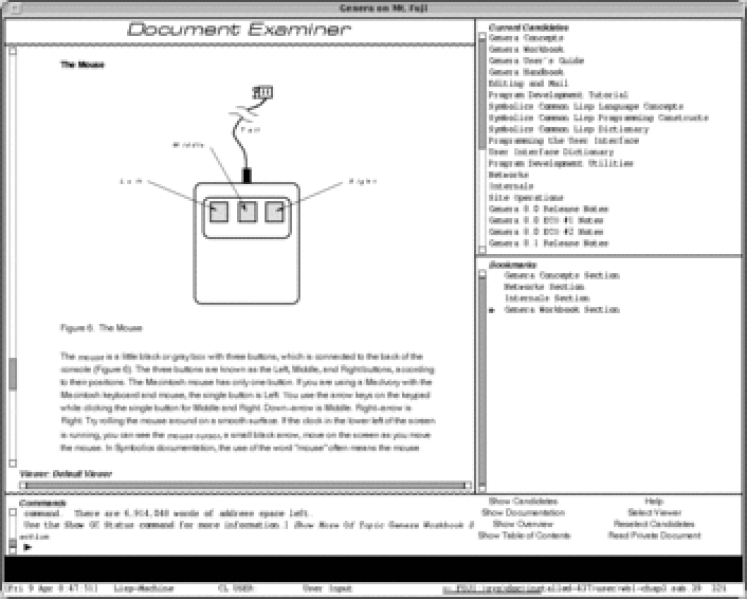
Consider the following image of a Symbolics hypertext system from the mid-late 1980s. Who noticed at the time? Who would've believed such a thing was possible then or even now using a "dynamic language"? 150 years from now what does anyone need to remember? A couple of blips maybe: Netscape and Excel?
Dmitry writes...
Groovy is interesting, but it's a dynamic language and has all the problems of dynamic languages. It's OK for small pieces of code. But building something the size of IntelliJ IDEA [in a dynamic language] would be a complete nightmare.So let's consider history's demonstration that this is false.
Since Smalltalk I've generally been using Eclipse for work stuff, but the effort in extending the environment has just been too much work for me to invest in, though I've tried a few times. I settle for writing ant scripts; that's how bad things have gotten - I'm programming in XML.And Joe Gregorio writes...What's on the horizon? Eclipse has E4. Which seems like it's largely a cleanup/sanitization of Eclipse, vs a complete re-think. I suspect I will write as many extensions for E4 as I have for the previous versions of Eclipse. Perhaps I'll sit that out and wait for Steve Northover's E5. Frankly, I think it's time we started fresh; let's call it F1.
Poor old disrespected Smalltalk, all those years of work, all that cutting edge research, and nary a bit of credit, which is particularly galling if you think about the fact that, to date, the language that has benefited the most from Smalltalk is Java.
Mike Herrick's posted an opening at CSI doing the open source incl. Rails and JRuby. Good folks to work with.
Monday's topic for the Portland Functional Programming Study Group (pdxfunc) has been announced. The meeting will take place Monday, June 9, 7pm, at CubeSpace on Grand Avenue.
Please join us at the next meeting of pdxfunc, the Portland Functional Programming Study Group. The group meets monthly for presentations, demos and discussions. We welcome programmers interested in all functional languages, and the meetings feature content for coders of all skill levels. If interested, please subscribe to our mailing list athttp://groups.google.com/group/pdxfunc
PRESENTATION:
Title: Functional programming with dynamic languages
Summary: Dynamic, multi-paradigm languages such as Ruby, Python and Perl allow programmers great flexibility in how they can write their code, although most use an imperative (AKA "procedural") style. However, using a functional style selectively can help provide clearer and shorter code, reduce bugs, and improve performance. This presentation will provide a basic overview of functional programming, sample code demonstrating how to use functional programming features of dynamic languages, compare and contrast code samples of functional and imperative styles, and discuss when each style is appropriate. No previous knowledge of functional programming is necessary.Bio: Igal Koshevoy is a Business-Technology Consultant with over a decade of experience creating sophisticated, business-critical systems using open source technologies. He is the author of an open source server automation toolkit available at "automateit.org", and supports local community efforts through Calagator, Portland Ruby Brigade, Portland Functional Programming Study Group, Legion of Tech, Ignite Portland, etc.
See you there!
PS: Sorry for the short notice, but Kevin's talk on XML parsing with Haskell had to be delayed. Hopefully he'll be able to present it next month.
From Steve Loughran...
SANS is issuing an emergency warning that XP SP3 installs a version of flash with security holes, even over a later version.And you use Windows, again, why?
News from Adobe today, heading in the direction they were talking about last year for PDF and Flash. PDF is an open standard. I don't know how that spec-wise matches what it takes for Adobe to incorporate SWFs into Reader, techno-wise, and stuff...
Two big announcements today. One, we’re announcing Reader 9 which includes the ability to render SWF content inside of your PDF. That means you can actually put Flash/Flex content directly into created PDFs. That opens up a lot of very, very interesting use cases like exposing form entry applications right inside of the document or starting to use a lot of video content inside of your PDFs. I think this is one of the more interesting things to happen with the Adobe/Macromedia merger. With PDF’s right’s management built in, this also provides you a way to protect your SWF content from being decompiled.I think it's cool. And another set of signs that Adobe "gets" some things competitors either don't get or have not figured out how to execute on successfully. This is all good news for "the office" and multiple offices working together over the internets. Not to mention education, entertainment, and everything else.The second announcement, my favorite of the day, is that we’re rolling out Acrobat.com. You’ve seen a lot of the services in different parts of the web, but we’re finally bringing them together under one umbrella brand with one account and a lot of functionality. You get Buzzword, “Share”, and “Brio” all as part of Acrobat.com and the line between the online software and the desktop software is starting to blur. For instance right from the Adobe Reader menus you can create a new Buzzword document or start a collaborative meeting in “Brio” which as been named Connect Now. Your Buzzword documents can now export to PDF and you can use Share to both create PDFs from documents as well as make it easy to send them to friends or embed them on your blog. There’s even an Acrobat.com AIR widget that lets you drag and drop files and create PDFs from them.
Also, via Mike Chambers today, a bunch of useful reference guide stuff from Adobe re: RIA and ActionScript.
I don't know. Maybe I am just an Adobe "fan boy" so to speak. I think they're doing a lot of things well.
Every now and then I complain about the browser's programming model. There's just been better models in the past on desktops, and there must be a ways forward that (1) "don't hurt the web" [see below] and (2) provide at least the ease of the popular models of the past. Most of the popular models of the past are based on some variation of Model-View-Controller from Smalltalk-80... frameworks like Swing, MFC, etc.
Those models are still incredibly low level compared to other practical-yet-relatively-unknown models that evolved over the last 30 years or more. Most of these other models that I can recall are all in the ballpark of contraint-based and data-flow-based systems.
Here are some off the top of my head for interested readers, many of whom I suspect may *only* have client-side experience with HTML and AJAX if they are younger than a certain age, maybe 35? I'll fill out links and descriptions as I get time.
At one brief moment, Dan mentions Fabrik, which is a visual data flow programming model he built at Apple in Smalltalk in the 80s.
http://methodsandmessages.vox.com/library/post/dan-ingalls-interviewed-on-floss-weekly.html

Bill de hÓra predicts...
if Gears (or something like it) becomes ubiquitous (and it will), then eventually XMPP will become a protocol option alongside HTTP, allowing data to be pushed down into the client.I'm for it. Note Adobe's AIR has all of these things, and then some, not to mention an API for either Flash/Flex or HTML/Ajax-based UIs.
I'd love to see more competion to the browser's current UI programming model, which is still what you are left with after adopting Gears. At least AIR gives you a choice, and Flex is open, so conceivably Google, Mozilla, or whoever could build off of Flex.
(I discount Lively Kernel for the time being. It's probably got more promise than I give it credit for. SVG has a lot of interesting capabilities especially for display, but it's still too clunky for the interactive bits. Kind of like NeWS vs. Display Postscript, ironically.)
Even Flex is so 1990s. There have been several significant improvements on that old MVC-ish model from the pre-web client/server days. Most of them in fact *pre-date* the 1990s adoption of Smalltalk's 1970s MVC. Still Flex is way better than HTML/Ajax for developer countenance though.
But one thing I've wondered is why the fascination with this service
that as far as I know is run by one outfit, has some "issues" (e.g. I
clicked on Mike Herrick's twitter URL the other day and each time saw
nothing but apologies from twitter for failing to work properly), and
is not federated across multiple providers as with, well, the web.
And I've wondered why people don't just use XMPP which is a federated
messaging platform with pub/sub topics etc. Or why not create a
twitter-ish system that can be federated.
So someone just published the source to an erlang-based twitter clone...
http://twoorl.com/
http://code.google.com/p/twoorl
I don't know if this specific clone is the answer, but it begs the question.
Via Signal vs. Noise, the following video is incredibly inventive. The theme becomes tedious for me before halfway, but still... I'd like to see more like this with a better story to tell...
Seen on InfoQ re: the Facebook Chat Architecture...
Another challenge was delivering messages in real time. Facebook choose a technique whereby the client pulls updates from the server, similar to Comet's XHR Long Polling Process...I am kind of amazed to see the attention Erlang has been given over the last couple two three years. OSCON in July here in Portland will have at least a three Erlang related sessions: a couple of tutorials and a presentation.Facebook choose a combination of C++ and Erlang to implement clustered and partitioned subsystems. The C++ module is used to log chat messages, while Erlang "holds online users' conversations in-memory and serves the long-polled HTTP requests". epoll, a new system call introduced in Linux 2.6, was used to drive the Erlang module. Eugene states why the decision was made to go with Erlang...
because the problem domain fits Erlang like a glove. Erlang is a functional concurrency-oriented language with extremely low-weight user-space "processes", share-nothing message-passing semantics, built-in distribution, and a "crash and recover" philosophy proven by two decades of deployment on large soft-realtime production systems...
The secret for going from zero to seventy million users overnight is to avoid doing it all in one fell swoop. We chose to simulate the impact of many real users hitting many machines by means of a "dark launch" period in which Facebook pages would make connections to the chat servers, query for presence information and simulate message sends without a single UI element drawn on the page.
InfoQ interviews Mike Herrick re: using Rails and JRuby for the CSI. Mike also blog'd about his project recently...
When deployed, UT-NEDSS project will directly contribute to the prevention of sickness and death by effectively collecting, identifying, tracking and trending information gathered about infectious diseases and bioterrorism attacks. Additionally, this unique partnership is providing lessons for public health informatics
There's been a stream of messages on the erlang list about RPC. Steve Vinoski's put an explanation of RPC and his position on his blog. Now he's followed up on the email list with a position on integration generally, and pub/sub messaging in particular...
One of the most effective forms of enterprise integration I've seen over the years is publish/subscribe messaging. I worked many years for CORBA vendors, and we'd often lose potential deals to messaging systems. Message queuing systems work well because (in no particular order):I agree with Steve's take. The best pub/sub mechanism I have experience with has been Tibco's rv. All the Tibco layers above it have been enterprisey bits to make a sale. The basic rv bus is super-easy to just use from C, Python, Java, anything. Horribly expensive back in the day, and I assume it still is.The problem with messaging systems, though, is that traditionally they've been quite expensive. Thankfully, I believe AMQP (http://amqp.org/) solves that issue nicely, and of course Erlang is the perfect way to implement it, which Alexis, Tony, and the rest of the RabbitMQ guys have already done (http://www.rabbitmq.com/).
- they don't pretend to be programming language procedure or method calls, so they avoid the associated impedance mismatch problems
- they don't try to hide distributed systems issues
- coupling is low -- drop a message into a queue here, pick up a message from a queue there
- queues can be persistent, or more generally, delivery guarantees can be varied as needed
- asynchrony
- payloads need not conform to some made-up IDL type system
- getting two different messaging systems to interoperate is easier than getting two different RPC or distributed object systems to interoperate
AMQP should have helped address this. But I've not seen much on the internets about AMQP over the last many months. I wonder if this is going to go anywhere? Or am I just missing the traffic?
I'm not sure XMPP pub/sub in the enterprise is going anywhere too quickly either, but that's another candidate for getting beyond vendor lock-in for enterprise messaging.
Why on earth Cisco is defining a new RPC protocol is beyond me.
And to any AMQP folks: the redirect from http://amqp.org/ seems broken.
Enterprises should be moving toward HTTP first and foremost, figuring out what's happening with XMPP for various other kinds of messaging, and/or AMQP in situations where HTTP and XMPP don't seem to cut it.
Matthias Felleisen is speaking at PSU a week from Monday (June 2). The
talk is open to the public.
"The First Year in Computer Science"
Matthias Felleisen
Northeastern University
2nd June, 16:40–18:00
Location: Hoffman Hall Rm 109, Portland State University
Abstract
My team and I have developed an alternative approach to the first-year courses on programming and computing. Unlike conventional approaches, ours focuses on designing programs in a systematic manner. The syntax of the chosen programming languages (both Java and Scheme) is only discussed as needed to support design principles.
Field tests with over 500 high schools and a dozen colleges have shown that the approach produces better students than conventional approaches that use a single language.
In several controlled studies, we could also show that students find our curriculum more appealing than the AP curriculum.
In my talk, I will provide an overview of the project, especially its intellectual premises and principles. My goal is to encourage you to think about the first year in a different way. The old ones are of questionable value. If we want our beautiful discipline to survive, we must find a good way of teaching it."
http://web.cecs.pdx.edu/~colloq/felleisen-firstYear.html for more information.
This is part two of my response to Ted Neward's latest misunderstanding of Erlang. Ted wrote to Steve Vinoski...
Sorry, Steve-O, but I think you're out in left field on this one. I'm happy to argue it further with you over beer, but if you want the last word, have at it, and we'll compare scores when we run into each other at the next conference.Everything I've read of Steve's tells me he's well informed by actual experience. Ted's writing exhibits the most basic misunderstandings. I wonder why Ted didn't spend a little beer time with some experts before attempting to write with supposed authority.
More from Ted...
any time we incorporate something directly as part of the language, there's all kinds of versioning and revision issues that come with it. This, to my mind, is one of Scala's (and F#'s and Lisp's and Clojure's and Scheme's and other composite languages') greatest strengths, the ability to create constructs that look like they're part of the language, but in fact come from libraries.Most of Erlang's power comes from libraries, but Ted wouldn't know that. Erlang the language is very small and expressive, but Ted wouldn't know that. Erlang's not really suffered from revision issues over the nine years I've been following the language, but Ted wouldn't know that. And Ted apparently didn't bother to ask anyone or read anything that might inform himself.
I agree with Ted's observation that extensible language syntax is desirable. Erlang's extensibility is cumbersome and not-too-beautiful. That's not the goal of Erlang though.
So you have to decide whether the benefits of Erlang outweigh issues like this. By the way, Gambit Scheme has Erlang-like concurrency performance, although shared-everything. But since Scheme can be used to define new languages such as Termite, it can be used to create syntactically-extensible Erlang-ish systems.
If you decide to go with Erlang the decision should be based on what Erlang is now, and not expect Erlang to change much. It's been largely stable as a language for years, as opposed to the arms race in Java and Java-like worlds. Language extensibility should not be as important to you as the simple Erlang programming model. This is a reasonable approach to take. Erlang is a known quantity, well proven. Not every language has to be as extensible as Lisp, in fact most are not.
Beware of languages like Scala and Clojure that intend to be safer concurrently than Java - they still run on the JVM and integration with Java code. So by definition their safety only can go so far.
I do criticize Erlang for having its own VM (though I think it's not a VM, it's an interpreter, which is a far cry from an actual VM)Maybe we should criticize Java for having its own JVM? Why doesn't it use Smalltalk's or Erlang's which pre-date the JVM? (Trick question. The JVM, and Hot Spot in particular, is based on ideas developed in Smalltalk, etc. Essentially the JVM is a dynamic language VM plus layers of cruft.)
Not much digging would have told Ted that Erlang compiles to native code or to an intermediate compiled code. Ted's misleading claims are heading into the dangerously ignorant. Why should I believe anything Ted writes about any topic? When Ted writes "I think that..." I think that we should read it as, "I'm guessing that..."
The JVM and the CLR have (literally) thousands of man-months sunk into them to reach high levels in all those areas. Can Erlang claim the same?Well, yeah. I don't know how many "man months" it stacks up to be, but Erlang has been around for decades in some very demanding situations. Did Ted bother to look into any of these VM questions?
Best part is, the IT department doesn't have to do anything different to their existing Java-based network topology to start taking advantage of this. Can you say the same for Erlang?If the architecture is going to change from "big, honkin' J2ee behemoths" to highly concurrent, lightweight interaction, then the topology should change. This is true whether moving from J2EE to Erlang or J2EE to JRuby/Rails or J2EE to Project Zero or J2EE to anything reasonably resembling modern best practices.
Moving to Erlang can take advantage of existing Java bits using the various network protocol standards or CORBA or SOAP or the JInterface class library which makes a Java application act like an Erlang node.
Frankly, whether the application you're monitoring hooks into the monitoring infrastructure is not really part of the argument, since Erlang doesn't offer that, either. I'm more concerned with whether the infrastructure is monitoring-friendly... if Erlang ties into SNMP out of the box with no work required by the programmer, please tell me where that's doc'ed and how it works!Apparently Ted's world of monitoring begins and ends with Java and dotnet's JMX and WMI. How would you monitor both Java and dotnet? SNMP likely. Both JMX and WMI can be hooked into SNMP. SNMP is the internet standard, more mature, and extends beyond Java and dotnet.
I've never used it, but just doing a quick check shows that Erlang has a pretty extensive SNMP api and Reference Manual, and User Guide. Hmm. Did Ted even bother to look?
Yes, the JVM could easily adopt the multi-process model if it chose to. (Said work is being done via the Java Isolates JSR.) The CLR already does (via AppDomains).I addressed Erlang vs. AppDomains in my previous post. These are clearly two different mechanisms with two different intents: AppDomains provide application isolation; Erlang processes provide finer-grained isolation of concurrent activities ("actor"-like) within an application.
Within an application neither the JVM nor the JVM-ish CLR provide Erlang-like processes. Scala and Clojure go a good bit of the way, but the advantage of Erlang is in its simplicity and combination of concurrency programming _and_ management. This goes well beyond a little bit of syntax around Java threads within a single JVM.
Barry Kelly has a really good blog post explaining more about these various VMs and Scala's Lift framework and implementation of Actors.
Here's an attempt to define terms more finely (finally?) after reading the latest (final?) response from Ted Neward to Steve Vinoski's attempts at helping Ted to clarify differences between Erlang and other languages and run-times, esp. those based on Java/JVM-ish. At a superficial level of understanding what Ted writes has some meaning. Just enough to be troublesome. So here's my pass at making clarifications.
The first terms to narrow in on are "process" and "thread" as they are used in various languages and operating systems. There are similarities for sure, but the subtle differences are the important aspects when making comparisons. Ted writes a few things using these terms...
Processes in *nix are just as vulnerable to bad coding practices as are processes in Windows or Mac OS XAside: Mac OS X _is_ Unix. But that's for a different debate on the merits of Windows per se.
Anyway. I don't expect anyone to argue with Ted on this point, so let's dig deeper into "bad coding practices" and processes. Erlang is a "mostly-functional" language and there is very little shared memory in its concurrency model. This removes many opportunities for bad coding. So can we say that programming an operating system process in Erlang is less vulnerable than programming an operating system process using most popular languages? I would say yes, generally.
the robustness and reliability of a system is entirely held hostage to the skill and care of the worst programmer on the systemThe emphasis is Ted's, not mine. There are many fine points to be made about this claim. One is the term "entirely" and another is the term "system". But first is the observation that this claim is about development practices more than anything else. To argue about language and mechanism shouldn't we assume that the teams are skilled at least in their own languages and mechanisms?
Let's say no and look deeper. You won't read much Erlang literature before you come across terms like robustness and reliability, and explanation of language constructs and framework mechanisms that support these traits.
On the other hand one can program in Java and similar languages for years before realizing that attention to robustness and reliability are even the developer's concern.
Back to "system" and "entirely" being at the mercy of the worst programmer. Perhaps the most important point made by the Erlang experts is to expect the worst and to design your system to recover from that. The Erlang culture does its best to help you isolate bad parts and the Erlang mechanisms make that isolation and recovery easier than with most other systems.
Erlang's model is similar to the CLR's AppDomain construct, which has been around since .NET 1.0, and Java's proposed "Isolate" feature which has yet to be implemented.I'm not going to presume to know anything more about AppDomains than Ted know's about about Erlang, but this comparison seems true only barely. Here's some information I found about AppDomains...
The main purpose of an Application Domain is to isolate our applications from other applications. Application domains run on a single Win32 process... Objects in the same Application Domain communicate directly while Objects that exists in different Application Domains interact with each other by transporting copies of objects to each other or by using proxies for message exchange (by reference).Any somewhat-skilled programmer familiar in the least with Erlang should be able to tell you significant differences between the AppDomain described above and Erlang's process model. I'm bothered that Ted Neward has such a large stage for making superficial statements that these mechanisms are in any way meaningfully the same. This is a significant disservice to programmers following his writing, trying to learn useful information. If Ted does not have (apparently) even a few days worth of reasonable Erlang experience or even reading, why should he presume to make such significant and horribly misleading statements to his large audience?
Here are the significant differences between these two mechanisms (Erlang processes and dotnet AppDomains)...
if the argument here is that Erlang's reliability comes from its lack of shared state between threads, hell, man, that's hardly a difficult architecture to cook up. Most transactional systems get there pretty easily, including EJB, though then programmers then go through dozens of hoops to try and break it.Ted does a pretty good job of hinting that EJB is a broken model. EJB isolation is more like an AppDomain. EJB separates one application from another, with fairly laborious mechanisms required to get them to communicate with each other.
Within an EJB application there is supposed to be no concurrency at all. And so again this is the opposite of Erlang. Erlang encourages high concurrency and ease of interaction. But these points are apparently lost on Ted. Usually one cannot read a single page of Erlang literature without having this made absolutely obvious.
The next post will get into Ted's arguments about language and common run-times.
(NPD Group)
http://blog.seattlepi.nwsource.com/microsoft/archives/138983.asp?source=rss
http://steve.vinoski.net/blog/2008/05/09/thinking-in-language-but-not-clearly/
I've seen several attempts to build "erlang in x" where x = common
lisp, python, java, dotnet, etc. To the extent I've followed them they
implement a fraction of the message passing and then don't go much
further. Scala, etc. on the jvm and those on other conventional
runtimes have a problem. Integration with Java instances within those
runtimes is not shared-nothing. You have to remain aware of what is
and what is not following the actor paradigm.
Erlang's JInterface is probably a better integration mechanism in the
long-run than running in the same shared-memory OS process.
As for monitoring, certainly a quick glance would have shown Ted there
is SNMP, as Steve points out. But also isn't the entire
process-linking and supervisor hierarchy an important kind of
"monitoring", i.e. "monitoring for availability"? This is something
all these other platforms lack.
So the more I think about it, the less suited these other platforms
are for messaging amongst themselves *or* for monitoring!
Then I came across Avi Bryant's post on Strongtalk, a high-performance
implementation of Smalltalk, correcting an apparently common
misunderstanding that the speed has something to do with the optional
type checker...
"Why do people make this stuff up? ... Strongtalk was that much faster
whether you used the optional static type system or not. Strongtalk's
optimizing compiler completely ignored the types, and it [types -ed.]
made your program run not one iota faster to add them."
"Designs are full of defaults--some explicit and most of the implicit.
Programmers don't pay enough attention to defaults. Rail's "convention
over configuration" is a great example of a system that carefully
thought through defaults. 37 Signals calls this concept opinionated
software."
http://www.windley.com/archives/2008/05/whats_your_architectures_agenda.shtml
"Mesh is the only thing that really makes sense out of a Yahoo
acquisition to me. Yahoo has rich content services—and they're
everywhere. If Microsoft could plug Mesh into that infrastructure,
fast, and flip the switch "Wow!" Imagine, for example, Mesh making
Flickr photos instantly available to all your PCs, cell phones and
TVs. Software plus hardware plus services."
But isn't that what the internets are for?
Carl Hewitt has a blog and an interesting History of Logic Programming. Also an interesting essay re: Wikipedia at http://wikicensored.info/
In addition to being such a simple and expressive language, Smalltalk should be known for its great collection of tools. Here's another one that was recently developed at UIUC, a Smalltalk Mecca...
Algernon was developed by Erik Hinterbichler and Joey Hagedorn with their CS598 classmates, working with Professor Ralph Johnson of the Software Architecture Group at UIUC. The developers say that Algernon provides lightning quick access to categories, classes, morphs, and global variables in your image, and is inspired by tools such as Quicksilver and LaunchBar for Mac OS X. Like Quicksilver, it learns from your behaviours, and will prioritise options that you use most often.

Michael Nygard posted about SAP's SOA capabilities. I wasn't sure if he'd appreciated their complexity, but he does emphasize that in a comment on this post here.
We're talking really complicated, WS-*-ish bits. My advice from hands-on experience two years ago would be: stop; walk back slowly, slowly; now turn and run; faster.
Not the kind of good system attributes I think of when reading Michael's book.
Roger von Oech via Gary King...
My mantra is “Look for the Second Right Answer.” This has been my guiding principle for over thirty years. Much of our educational system tries to teach us to look for the “one right answer.”I find that looking for the second right answer is an incredibly easy way to open my mind. For example, when I’m looking for information, this mantra tells me to go beyond the right answers that have worked in the past and look for others. When I’m trying to be creative, it playfully advises me to put my ideas in unusual contexts to give them new meanings.
Update: Keith Gaughan in the comments points out Yahoo is a FreeBSD shop primarily. I stand corrected. However I assume any "cloud" OS services would provide Linux as their primary platform. End.
The downside of MSFT dropping the bid is we don't get to see what their strategy would have been. Would they have attempted to migrate everyone over to the Windows platform? Really?
Would they have dropped the reported Yahoo move into providing cloud computing services? (I assume these would/will be based on Linux and open source generally. Who would do or could afford otherwise?)
How could MSFT purchase on open-source Linux based company without migrating to Windows or altogether dropping the open source Linux bits? I suppose they could move all the Linux bits to Novell / Suse. But that's still an endorsement of Linux generally, which in spite of the Novell arrangement MSFT still detests.
Do they just pull a 180 and hope to become a true Internet / Linux / OSS company over night? That would be *something*.
Sit back and think about it. Wow. Is Microsoft stuck in a bad place with the Internets or what?
From Dan Farber on CNet News: Google CEO Eric Schmidt and IBM CEO Sam Palmisano getting all, well, Googly-eyed with each other...
IBM is taking some of the learnings from the project and plans to operate a cloud that will allow partners to house their Web-based applications and sell them to customers, Palmisano said. "It is the first time we have taken something from the consumer arena and applied it to the enterprise," he said.Schmidt said that over time there won't be much differentiation between consumer and enterprise architectures. The major difference is that enterprise customers will pay for software and services, with required security and other features, and consumers won't...
Google's YouTube captures 10 hours of video every 60 seconds, and IBM might like that business if it could figure out how to make money at it. But eventually, IBM, Microsoft, Sun, Google, and other big players will look more similar in their technical architectures and business models...
Currently, Salesforce.com is selling Google Apps as an integrated part of its platform. It's not far-fetched to think that Google would seek out IBM's help with its business partners to spread the Google word in the enterprise.
Gary King on the horribly underreported conflicts of interest with former military leaders simultaneoulsy taking positions as Big Media war analysts and going on the take as contractors and investors in the military-industrial complex. Does anyone care that the Pentagon's coaching these slimy bastards went up to at least Rumsfeld (at the time) and porbably well into the Whitehouse itself?
Billions of USD are being wasted (and in fact borrowed from China, et al.) EACH MONTH lining the pockets of the people who go on TV and play up the war in order to attract advertisers and instill fear in the general population. Meanwhile baby-faced young men and women are losing limbs, their brains are shelled into jelly, and losing their lives.
I'll vote for any presidential candidate who promises to reinstitute the draft, without exceptions. That is the only action I can see ending this boondoggle in the next year or so. That is the only thing I can see getting enough people's attention to really care about the endless death and destruction and blatant robbery and profiteering. As long as the vast majority of our children are safe, we seem unable to care about those who chose to protect our _constitution_ and have wound up losing their lives and limbs doing anything but.
Why we've not gone up to the door of the Whitehouse and dragged the bastards directly into the courts ourselves is beyond me. Now excuse me, American Idol is on.
Oh and remember: the next president will likely nominate three supreme court justices. And you want McBush, er, McCain, to be the one for that? As long as you like the concept of the "unitary executive". W's men are already on the court putting this theory into practice.
"Rubinius switched from C to C++ to implement it's core VM"
For the life of me I cannot understand why projects use C++ rather than Objective-C. Hmm.
Catching up on comments to this post...
Yeah, I can be too brief sometimes. Here's the essence of what I like about ObjC vs. C++. ObjC attempts to keep the Obj and the C distinct, while C++ attempts to combine them. As a result the Obj in ObjC is very much like the Obj in Smalltalk. And the C on Obj C is very much like the C in ANSI C.
The Obj in C++ is significantly more complicated than the Obj in Smalltalk or in ObjC. The C in C++ is also significantly more complicated, to the point where I don't think it can be called "C". People will talk about the expressiveness of C++ and how much it has evolved over the years. I still very much prefer the simplicity of ObjC.
I am also surprised the ObjC has portability issues. With the GNU implementation?
And I am surprised about the Ruby kernel issue as well. I also thought this would be so small to warrant just C or even better, a subset of Ruby that compiles easily into C. This is what Squeak uses for its kernel. Gambit Scheme does something along the same lines, allowing a very C-ish dialect of Scheme that translates directly.
What about McCain's follies, e.g. singing "Bomb, bomb, bom, bomb. bomb
Iran" to the tune of the Beach Boy's "Barbara Ann"??? Do you want this
person to lead the free world???
What about McCain refusing to stand down from John Hagee's
endorsement??? Hagee being the self-proclaimed "Christian" who to this
day believes the flooding of New Orleans after Hurricane Katrina is
due to homosexuality.
Politics. I'm not crazy about Obama or any candidate, but I'll take
anyone who's a bit more on stable ground than McCain. Holy cow.
In a comment on James' post, about Obama, the comment claims that…
"Every day a new skeleton comes out."
Do we have a list of these skeletons somewhere? Every day since when?
How many skeletons are there?
Does Obama have a track record in government of legislating along the
lines of what this supposed Manchurian Minister would dictate?
Is the Big Media doing a service or disservice on this topic? It seems
not to be digging deep about anything, certainly not about Obama's
actual track record and certainly not anything about the untouchable
McBush, I mean, McCain. The Big Media does seem determined to keep the
wound open and never find a way to close it one way or another.
People get the government and the media they deserve, to borrow a
phrase from Phil Windley.
Update:
I'll tell you what, looking at the comments over on James' post, it's *rul* scary how different people's opinions are from mine. There is a *huge* divide in our thinking. I don't know if I'm right or not, but I have my guesses.


